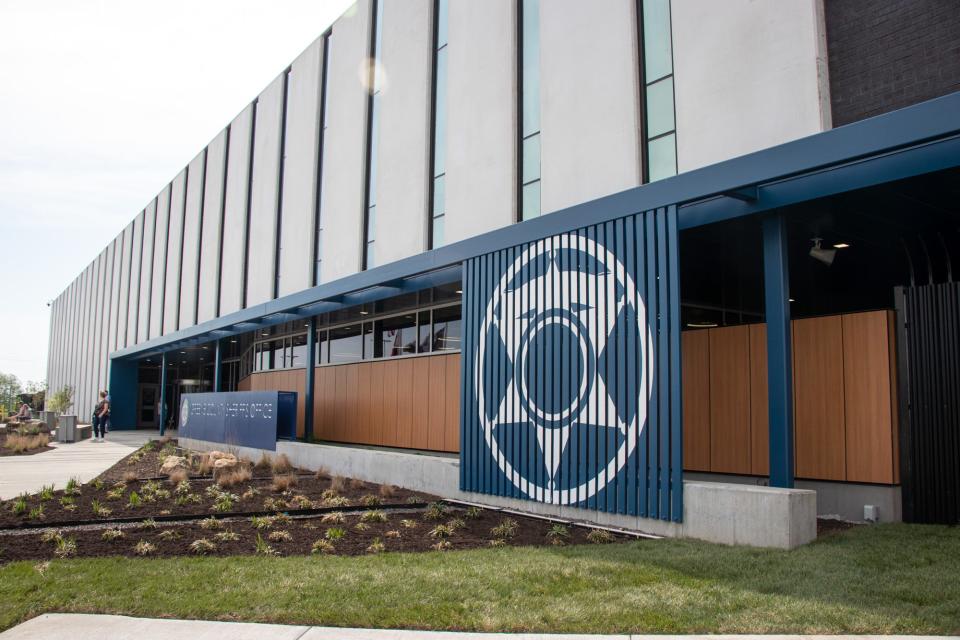


Lapeer County CMH Marketing and Communications Coordinator Arizona Goulet and CFO Emma McQuillan are just two of the more than 150 individuals who work to help local people navigate mental health challenges. Photo by Krystal Moralee
MAYFIELD TWP. — This year, Lapeer County Community Mental Health (CMH) is celebrating 50 years of service to the community.
In 1963, the Federal Community Mental Health Centers Act passed, prompting the Michigan Legislature to pass the Michigan Community Mental Health Services Act, which shifted the responsibility of developing mental health services in the community from the state alone to include local units of government. It wasn’t until December of 1971 that the Lapeer County Board of Commissioners voted to establish a CMH program in Lapeer County. The following year, in April, the first organizational meeting of the Lapeer County Community Mental Health Services Board was held, and services to the community began in 1973.
During the first couple years of service, CMH contracted with other agencies such as Catholic Social Services of Lapeer County and Lapeer Adult Activity Center to provide clinical services and activities for people with developmental disabilities, respectively.
Soon thereafter, CMH began growing its staff and expanding services. The total budget in 1973 was $149,047 compared to today’s budget of $32 million.
CMH’s original office space was located on the grounds of the Oakdale Regional Center, and it moved in fall 1973 to the second floor of the Lyle Stewart building. In 1980, CMH moved to larger quarters on the first floor of the building.
In conjunction with the Lapeer County General Hospital, in 1985 an in-patient psychiatric unit was established at the hospital. At the same time, CMH was using a room at Cramton Elementary to conduct a part-time day activity program for people with developmental disabilities. In response to the need for additional office space, CMH began locating services in different places, including the Heritage Square complex in Lapeer and in Otter Lake.
After many years of planning, on June 16, 1990, three of CMH’s four offices were moved into a new 32,000-squarefoot building, with wings dedicated to outpatient clinic services, services for people with developmental disabilities, day programming, and administrative services, around a central core of support services.
As the 1990s progressed, CMH began offering psychosocial rehabilitation using the clubhouse model, home-based services for high-risk children and their families, and the Thumb Mental Health Alliance was formed to increase assistance to people covered by Medicaid. The alliance’s participants shifted over the years, and these days it is the Region 10 PIHP, covering Genesee, Lapeer, Sanilac, and St. Clair counties.
Lapeer County Community Mental Health has continued to grow and adapt over the years and was one department that kept its doors open to the public for face-to-face services during the COVID- 19 pandemic, though CEO Lauren Emmons said the pandemic also dramatically increased the usage of telehealth services throughout the field.
In 2022, Lapeer County CMH was awarded a federal grant of nearly $1 million per year for the next four years, recognizing Lapeer County CMH as a Certified Community Behavior Health Clinic (CCBHC). Beginning the implementation of that program, which will begin with hiring staff, is Emmons’s biggest priority for 2023.
According to the Substance Abuse and Mental Health Services Administration (SAMHSA), which is where the grant came from, CCBHCs are required to provide a comprehensive array of behavioral health services so that people who need care are not caught trying to piece together the behavioral health support they need across multiple providers. In addition, CCBHCs must provide care coordination to help people navigate behavioral health care, physical health care, social services, and the other systems they are involved in.
With the awarding of the four-year SAMHSA grant, Lapeer County CMH will be expanding a couple of evidence-based practices to assist individuals. One is the DIMENSIONS: Well Body Program, which offers care providers knowledge and skills to promote physical health and well-being including strategies for coping with stress, healthy sleep, healthy eating, and physical activity as well as ways to promote positive behavior change through motivational engagement and behavior change strategies. The second is enhanced illness management and recovery, or IMR, which is an eight-week psycho-educational class that teaches people skills and techniques that helps them better manage their mental illness and any obstacles they may face as a result.
A big challenge, however, is the lack of candidates. Across the state, Emmons said, there are an estimated 15,000 openings for professional CMH staff.
“The challenge right now is staffing capacity. There are not enough master-level clinicians in the state of Michigan, and we are competing,” he said. “If I could fill the staff tomorrow, we could have our doors wide open.”
Moving forward, CMH is also working on providing more substance abuse services, and Emmons said they are in discussions with the county to potentially move the Alcohol Information and Counseling Center (AICC) from under the umbrella of the Health Department to CMH. In the future — though certainly not before he retires in January — Emmons said they’d like to move CMH toward becoming an independent government agency instead of being under the county as well.
In addition, after the Department of Health and Human Services lease is up in the building at 1505 Suncrest Drive in 2025, that building may be utilized to house several programs through CMH that need more space, including the children’s services, the autism benefit program, and the Stepping Stone day program.
Overall, CMH’s primary service demographic is people with Medicaid and people with no insurance, though the upcoming expansion of services is intended to open up assistance to a broader population.
“Our hope is to be the premier provider of mental health and substance abuse services in Lapeer County, regardless of insurance status, income status, whatever,” said Emmons.