

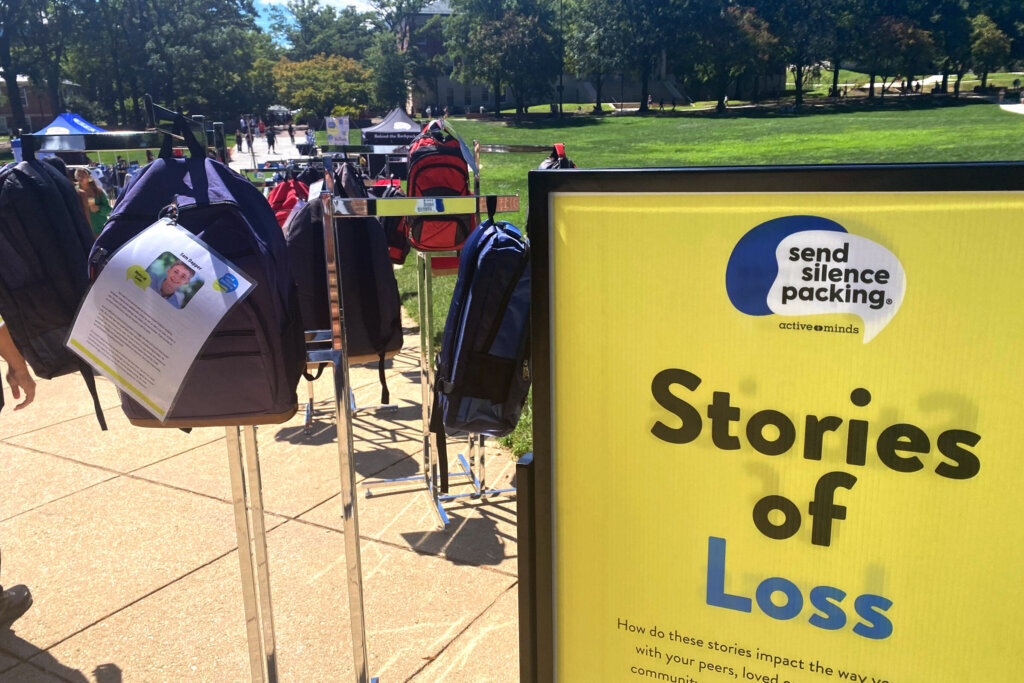

Backpacks at the University of Md. were part of a traveling visual exhibit called Send Silence Packing, which hopes to raise awareness about mental illness and suicide.
Along the busiest sidewalk cutting across McKelding Mall at the University of Maryland, about 100 backpacks dangled along racks. Impossible to miss, they weren’t waiting to be taken to class or to a dorm. In fact, they didn’t belong to anyone at the school.
The backpacks were part of a traveling visual exhibit called Send Silence Packing, which hopes to raise awareness about mental illness and suicide. Created by a nonprofit called Active Minds, those who walked through the exhibit could see each backpack told a story.
Coming from the Campus Drive side of the mall, students were hit with stories of how suicide has cost people a friend or family member. But next to those were other backpacks, featuring the stories of survivors — those still struggling with mental health and working to find help: stories of those who got themselves to a better place.
Scattered about the exhibit on Thursday and talking to fellow students, were members of the Maryland football team.
“The masculine way of handling things is, we don’t talk about it,” said quarterback Taulia Tagovailoa. But that exhibit, he said, “helps people, guys and girls too, open up about if they’re having bad days, or not feeling good, or holding on to something … that they can talk to people they can relate to.”
“It’s hard for us to reach out and speak to someone about our problems, rather than dealing with [it on] our own,” said Jaquan Smith, a cornerback with the Terrapin football team. “We all have that problem, that difficulty with just introducing the topic.”
Another Terp, Robert Smith, said he hit a low point in life a few years ago when his mother passed away from breast cancer. He admitted there were times he wasn’t sure life was worth living.
“Your body is like a water bottle. If you keep filling the water bottle all the way to the top, the water is going to fall out,” said Smith.
“Same with your body. If you keep stuffing your feelings and stuffing your feelings, eventually they’re going to have to come out somehow, some way — and you may not know why.”
He found help and support from others, in part, by allowing others to open up to him.
“As I’ve seen other people be vulnerable, it’s allowed me to be vulnerable,” said Smith. “I do believe if I show somebody that I can be vulnerable with you, I think it makes it that much easier to be vulnerable with me.”
The backpacks on display at University of Md. are part of a traveling visual exhibit called Send Silence Packing, which hopes to raise awareness about mental illness and suicide. (WTOP / John Domen)
With mental health experts and support staff also on hand, that was the whole point of the exhibit.
“The journey is everlasting,” said Joy Sheppard, the director of community programs with Active Minds. “We want them to know that it’s OK to slow down. It’s OK to take care of themselves. It’s OK to put boundaries up and ask for self care, get self care and get resources.”
The exhibit kicked off the school year in College Park, but will travel to college campuses throughout the country. Robert Smith said walking through the backpacks had an impact on him, and it was important to see those other stories of success.
“When you see that somebody is in the same place as you, and was in the same position as you and came out of it better and came out of it a different way … it allows you to think ‘well OK maybe that could be me,’” said Smith.
Walking through the exhibit between classes, Emily Pena, a junior at Maryland, stopped to read some of the stories meant to offer hope.
“Just seeing these kind of made me feel less alone,” said Pena, who mentioned she’s had her own battles with mental health. Reading the stories of success, she admitted “it makes me feel like there’s a way out of those states of where you feel hopeless … things, at one point, will get better.”
“It’s OK to have bad days,” said Sheppard. “A lot of people take everything internal. We want to make sure they know it’s OK to reach out for resources, to break the stigma.”
Get breaking news and daily headlines delivered to your email inbox by signing up here.
© 2023 WTOP. All Rights Reserved. This website is not intended for users located within the European Economic Area.