


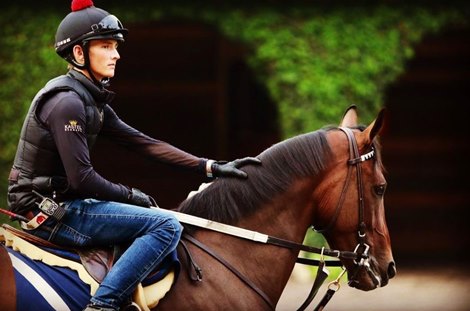

“We’re here to destigmatize the conversation around mental health,” said Donna Barton Brothers, opening a discussion on jockeys and mental health, hosted by HISA and the Jockeys’ Guild at the National Museum of Racing and Hall of Fame in Saratoga Springs, N.Y., on Aug. 1. “We’re also here to dive into solutions.”
Comprising a panel discussion and short presentations, the three-hour event covered topics such as nutrition, addiction, and the systemic lack of mental health resources available to riders.
“Jockey safety, both physical and mental,” said HISA CEO Lisa Lazarus, “is at the core of HISA’s responsibilities.”
She outlined two initiatives that are being implemented—Head Check, a concussion management platform designed to improve the management and care of riders with concussions or suspected concussions, and NovaCare, a health-care company that will provide physicals and concussion-baseline testing for jockeys at a discounted price.
The panel comprised retired jockeys Richard Migliore and Eurico Da Silva; current rider Trevor McCarthy; podcaster and race analyst Jonathon Kinchen; and Dr. Yuval Neria, co-director of the Man o’ War Project, which is based at Columbia University and researches the efficacy of equine therapy on military therapy.
Sign up for BloodHorse Daily
A veteran of more than 30 years in the saddle, Da Silva spoke frankly about seeking help for addictions to sex and alcohol.
“It took me a long time,” he said. “I was 29 years old when I got help. I’ve suffered a lot ever since I was young, with anxiety and low self-esteem. I was ashamed to go for help; there was a big barrier inside myself, that if I go for help, I’m weak, I’m a failure.
“I constantly had thoughts of suicide. I was suffering so much from that pain that I finally broke that barrier inside myself and went for help.”
Now a certified mindset coach, Da Silva wants to help other people recover as he was able to.
“Going to therapy was the most important decision I’ve made in my life,” he said.
McCarthy and Migliore talked about the pressure both to win and to make weight, and the effects that hunger and deprivation had on them, noting that the food in most jockeys’ rooms is not particularly nutritious.
“On the big days, there’s a big spread in the jockeys’ room,” said McCarthy. “Chicken parmigiana, shrimp parmigiana—it blew my mind. What do you want me to do with this? I call it the ‘valet buffet.’ ”
Migliore agreed.
“The food in jockeys’ rooms around the country is more for other people, not for the jockeys.”
“It’s tough to hear about people being forced to reduce or maintain weight,” said Dr. Neria. “For me, as a medical expert, it feels not really human or moral, especially when energy is needed to do the job as good as you do. You don’t want to deprive your body so much.”
He also linked food deprivation to mental health issues.
“Being deprived of nutrients is very much related to anger,” he said. “And anger is a complement of depression and PTSD.”
He also suggested that jockeys’ physical ailments, such as concussions or other injuries sustained while riding, could be related to nutritional deprivation.
Present at the event were the families of Avery Whisman and of Alex Canchari, two jockeys who committed suicide this year.
“The day after Avery died, the media wanted to know what happened to this jockey,” said Whisman’s mother, Dr. Salli Whisman. “We said that he had an illness, and he died because of that illness. We also raised the question [of how] this industry contributed to his illness.”
Photo: Courtesy Carla Gaines Racing Stable
Avery Whisman
Six months later, she said, she got a call from Dr. Peter Hester, HISA’s national medical director, whom she had met when they both attended medical school at the University of Kentucky.
“I didn’t expect to hear that HISA had been working on this,” she said. “Avery had been in their minds and their hearts and their eyesight, and our comment had taken root. It wasn’t going to be dropped or left alone, and it wasn’t up to us to make sure that something was done.”
“Untreated head injuries are a recipe for disaster,” said Dr. Ashley Canchari, Alex’s sister. “Alex thought he was a failure at life and worthless, and that’s not the Alex I had ever known. It goes to show how mentally broken down he had come in recent years.
“I’m thankful that some good has come from my brother’s passing, in recognizing the importance of mental health, but know that there is so much more that can be done.”
Earlier this year, HISA sent a survey to approximately 1,000 jockeys across the country, receiving back about 230. The top three stressors riders listed are making weight, the pressure to win, and financial insecurity.
Closing the session, HISA’s Lazarus said, “We need deliverable outcomes, not just sharing emotions. We need to understand what is going to work in this community.”
To that end, HISA will create a steering committee that will draw on opportunities and facilities at Columbia University to create a program to address jockeys’ mental health.
Among other ideas discussed as possible next steps was to staff all jockeys’ rooms with a mental health professional.
Earlier in the day, former NFL player Randy Grimes gave a keynote, focusing on his addiction to painkillers and his recovery. Other speakers included Terry Meyocks, president and CEO of the Jockeys’ Guild, and Dan Waites, executive director of the Race Track Chaplaincy of America.